


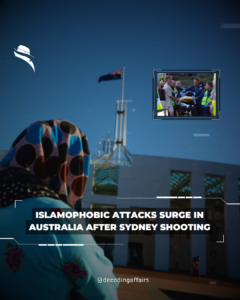
Sydney, Australia — Muslim advocacy groups in Australia are reporting a sharp escalation in Islamophobic incidents following a deadly Sydney Shooting last month, with women emerging as the primary targets of harassment and physical abuse.
According to Australia’s National Imams Council, reported anti-Muslim incidents have increased by nearly 200 percent since the December 14 attack that killed 15 people. The council says the spike began almost immediately after the violence, despite authorities stating there is no evidence linking the perpetrators to organised terrorism.
Most of the reported incidents have occurred in Sydney and have disproportionately targeted Muslim women, highlighting what community leaders describe as a recurring pattern of collective punishment following major security incidents.
Women Bear the Brunt of Abuse
Among the reported cases, a Muslim woman assisting people with disabilities on a public bus had her hijab torn off by a couple. Another woman was pelted with eggs while commuting to work, while a third was spat on in a separate incident. Advocacy groups say such attacks often go underreported due to fear of retaliation or lack of trust in enforcement mechanisms.
The council also reported vandalism and serious security breaches at several mosques and Islamic centres across New South Wales, raising concerns about the safety of communal religious spaces.
Police Reject Terror Cell Claims
Australian authorities have sought to distance the attack from broader extremist networks. Police investigators confirmed that there is no evidence linking the Sydney shooters to a larger terrorist cell, urging the public to avoid speculation that could inflame tensions.
The shooting was carried out by a father and son during Hanukkah celebrations at Bondi Beach, a major public gathering point in New South Wales. Fifteen people were killed in the attack, along with one of the perpetrators. Hanukkah commemorates the Maccabees’ victory over the Seleucid Empire in 165 BCE.
Despite the absence of ideological links identified by investigators, Muslim groups say the backlash demonstrates how quickly minority communities become targets after high-profile violence.
Political and Policy Fallout
The rise in Islamophobic incidents follows heightened political discourse around security and symbolism. Earlier this month, Australian authorities moved to restrict public displays of Hamas and Hezbollah flags following the Bondi Beach attack, citing public order and safety concerns.
Civil rights advocates argue that such measures, while framed as security responses, risk reinforcing public suspicion toward Muslim communities when not accompanied by clear messaging distinguishing perpetrators from entire religious groups.
A Familiar Pattern
Community leaders note that the current surge mirrors past episodes in Australia where violent incidents — regardless of motive — have been followed by spikes in anti-Muslim abuse. Rights organisations warn that failure to address misinformation and collective blame creates an environment where hate crimes flourish.
The National Imams Council has called for stronger public condemnation of Islamophobia, improved protection for religious institutions, and clearer communication from political leaders to prevent further escalation.
As investigations into the shooting continue, Muslim advocates stress that accountability must be directed at individuals responsible for violence — not entire communities already facing heightened vulnerability.